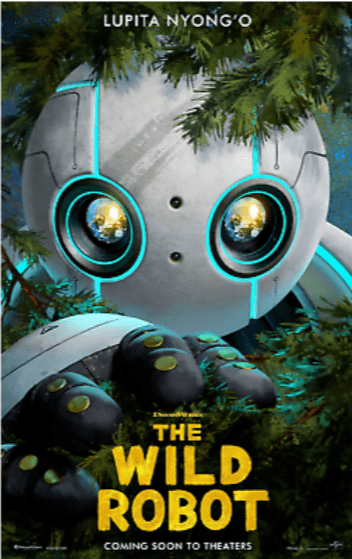
The Wild Robot is a Family Adventure Animation produced by Dreamworks Animation and distributed by Universal Pictures.
Clearly directed to a broad audience, the story has a variety of messages. From being an outsider to the effects of climate change, the trials of motherhood, the brutality of nature and the advantages of humanity, this film covers enough moral ground to be reasonably thought-provoking for the entire family.
It explores these themes with a genuine simplicity that is subtle enough to avoid the trap of seeming preachy. One of my favourite family films is WALL-E, and I have heard plenty of comparisons being made – particularly with one scene in which Roz and her “son” has a moment of connection that inspires her memory to come back alive. However, WALL-E is quite heavy-handed with its message (skyscrapers of rubbish will do that). Meanwhile, The Wild Robot focuses less on the environmental issues caused by humanity and more on the humanity of the characters themselves.
All character-led films have the potential to show their world through a lens you can easily sympathise with (take A Quiet Place for example). This film does the same, with characters that are all very entertaining.
Even with her robotic characteristics, Ros’s Lupita Nyong’o creates both humour and humanity for the character she portrays. She isn’t the only one. Kit Conner’s character of Brightbill was also amazing, although I do wonder why they could not select an American actor for this. Other honourable mentions include Pedro Pascal as the mischievous Fink, Bill Nighty as Longneck and Catherine O’Hara as tired mother, Pinktail.
One of the unique characteristics of this film was the language used between the characters. In blunt terms, it is blunt. Perhaps this is expected – in pop culture, robots are generally coded to be honest. If animals were to talk, then I can presume they would also be honest (if my nonchalant cat were to begin talking, I fear of the judgemental things he would tell me).
The brutality of nature is discussed heavily in the film – be aware, you will see dead animals. But this topic is a ripe ground to explore the clash and harmony between humanity and nature. The film does well to show the chemistry between the best parts of humanity (the ability to care, even when it is not suitable for surviving), and the best parts of nature (adaptability).
The more sombre matters surrounding the difficulties of survival and death are seasoned with dark humour. That being said, the humour is not pitch-black. In fact, the humour is about as light as dark humour can be, but there were times when I was laughing loudly in the cinema – maybe more so than the children.
As for the plot, it was predictable for the first half. The trailer moments (found mostly in the first half) were perhaps wasted, I’d have found it more impactful if they were placed somewhere later in the film. I got worried thinking I had seen the best parts of the film so early on.
But I found these moments enjoyable nonetheless. With stunning visuals and an amazing soundscape, the first part of the film has a level of creativity you would typically see in a short animation film. The second half of the film was less predictable, which accounted for the halfway lull I started to feel after what I thought was the climax.
I was never completely bored, however. From a visual perspective, this film is essentially brain candy. With a hand-created digital art look, there is something artisanal in its approach. My eyes certainly appreciated that.
In summary, The Wild Robot is a beautiful story with a lot of heart, incredible voice acting, and a decent story. Although the story was somewhat simplistic (as you might expect with a family film), the internal and external interactions between the characters were entertaining enough that I was invested throughout.
The true antagonist was the issue of disconnect – in the beginning, between Roz and the animals, her “son” and then with the society that made her. Eventually, this is all resolved through the connection between the animals, inspired by Roz, who learns to connect with her inner “wild robot”.

 Kara Joubert: Writer, Journalist & Filmmaker
Leave a comment