Talking Olympics with John Goodbody, Poetry with Fiona Theotrikoff, India-Anglican culture with Clare Jenkins, and the York Maze exploration with Tom Pearcy.
With Jessica Burtis, Kara Joubert, Fia Van den Bogert, Ana Cosconel, Merryn Hobson, Cathy Manso and Alex Lewczuk.
Elly Sample, Kara Joubert, Victoria Simmonds, Ana Cosconel, Jonathan Linsley, Cathy Manso, Sarah Huntley & Alex Lewczuk with approx 90 mins of audio entertainment to wrap up 2025 AD
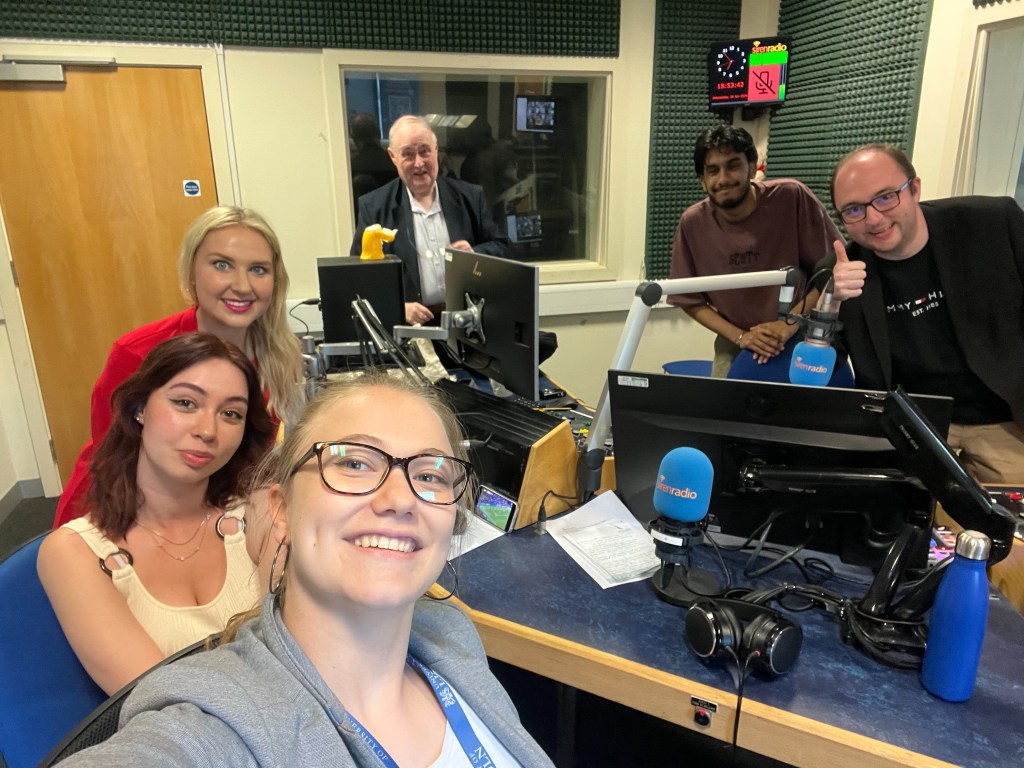
The last Midweek Live Drive from the Siren studio before its closure and licence transfer.
With 24 souls bravely covering topics, including Ed Sheeran’s to-be tour chef Stacy Leith, Newark Book Festival’s Jack Cornish, Doctor Who discussions with Alan Steven, Authors Jennie Fincg and William Coles, as well as Jessica Burtis, Tosin Soyemi, singers Chloey Rose and Victoria Simmonds, Doctor Who director Graeme Harper, Phil Hurd-Wood, royal commentator and arts critic Richard Fitzwilliams, Lily Holleman, Tessa Snart, Keith Taynton, Gabrella Peralta, Ciara Mullins, Cathy Manso, Ben Lewis, Fia Van Den Bogart, Jodie Harrison, Meryn Hobson, Ana Cosconel, Kara Joubert and Alex Lewczuk.
Elly Sample, Kara Joubert, Victoria Simmonds, Ana Cosconel, Jonathan Linsley, Cathy Manso, Sarah Huntley & Alex Lewczuk with approx 90 mins of audio entertainment to wrap up 2025 AD
Listen to the Part 2 Day 2 segment of Southside Broadcasting’s coverage of the event in which Ana Cosconel, Kara Joubert, Alex Lewczuk, Sue North, Charlotte Powell, Alan Stennart, Kay, Stuart Barnes, Goats, Bees, Cattle, American Footballers and more provide 87 juicy audio minutes from the second day of the Lincolnshire show.
Who shall we watch for as the next generation of filmmakers graduate?
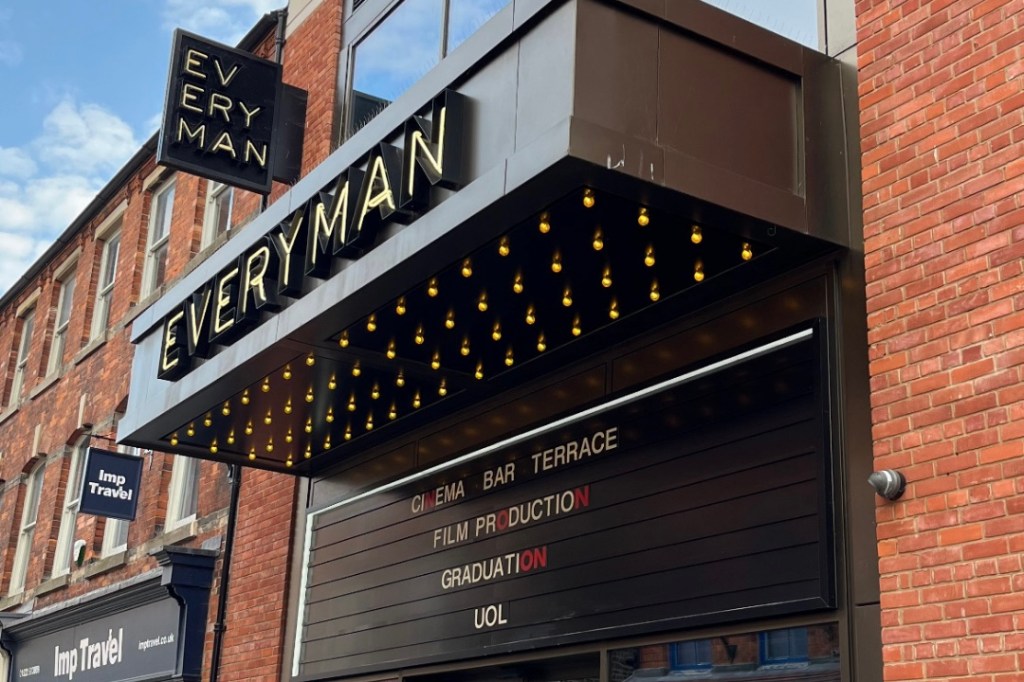
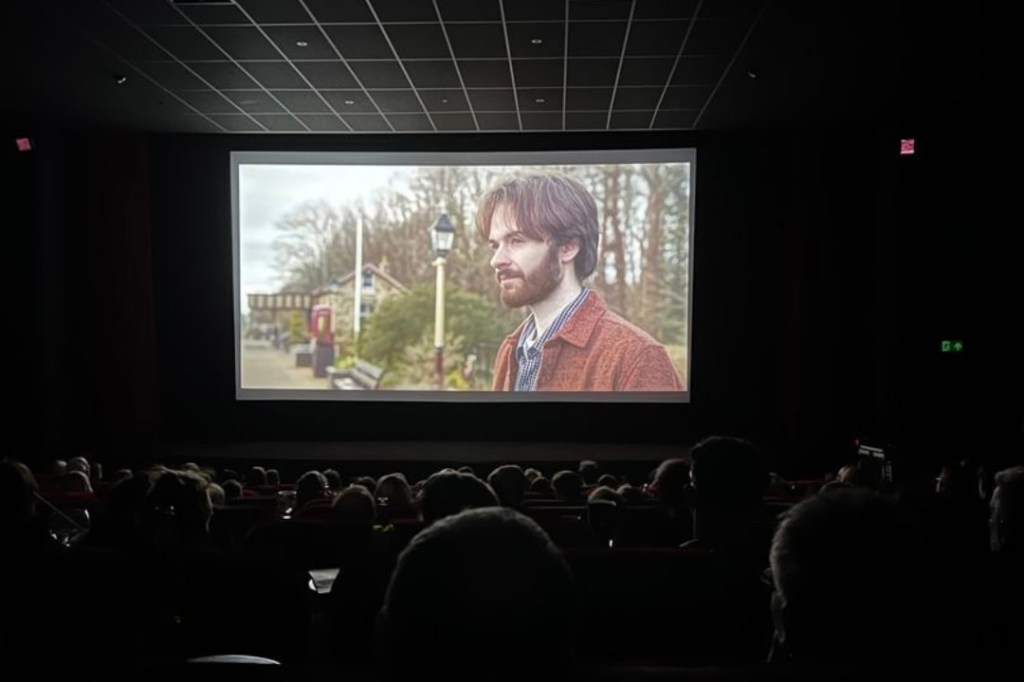
Film students at the University of Lincoln attended their 2024 graduation screening at the Everyman Cinema with the short film Off-Track winning every award.
This was the second annual screening of the graduation films through the venue which hosted actors, students, lecturers and parents alike.
It did not take long before Everyman’s halls were packed with excited faces. One of those belonged to Alex Morningstar, whose last name seemed fitting as the star of two of the films showing.
Alex’s mother, Verity Oliver was evidently proud, saying there was “so much potential in the room” that night.
Alex Morningstar shone in the films Off-Track and Father’s Day. Credit: Daria Chyzhyk
The air was an electric mix of nervous popcorn and excitement, because the night was not just a screening, but an awards opportunity as well.
Of course, the awards were not the focus of the evening – after all, the night was a celebration of everyone’s hard work – but they were definitely in the peripherals.
The film awards up for grabs were for Best Screenplay, Best Post-Production and Best Cinematography.
There was also a Best Film Production Student award being offered.
For Best Cinematography, the award included access to PixiPixel filming equipment, worth thousands of pounds.
Some students were given their Arri certification on the night. Credit: Daria Chyzhyk
Student Blake Metcalfe said: “In my opinion, everyone deserves to be nominated.”
Although it was true that every student’s film received a well-deserved applause, only one would end up winning all the awards.
The films showing were Off-Track, The Egg, Father’s Day, No Days Off for Death, Julie Burroughs, Questioning, and Vanishing Act.
Another film, On Tilt, was initially planned to be screened, but unfortunately was cancelled due to technical issues.
There was a varied collection of themes, ranging from the morbid with real pig eyeballs to the tender with imperfect father-and-son relationships.
After the films, students waited in their velvet seats in anticipation of the awards to come. One of those was Oliver Townsend.
Oliver, 23, has been a go-to student for cinematography at the University of Lincoln.
He went on to win the cinematography award for his work in Off-Track, which was the “Oppenheimer” of the evening, making a clean sweep of all of the film awards.
Off-Track’s crew went on the stage to receive their awards. Credit: Daria Chyzhyk
The Lincoln-based cinematographer told me: “Winning the award meant the world. I am just so grateful I got to come to this university at this time because I couldn’t have done it without everyone here.”
Oliver said: “Everyone on the course is no nice and collaborative and I’ve learnt so much from them, the tutors too of course, I couldn’t have asked for better cine lecturers than Jack [Shelbourne] and Zeta [Spyraki]. I’m just really appreciative for my time at the uni and I think this was the perfect way to cap it off”
That night, there were whispers that Oliver might win the Best Film Production Student award as well, although this went to Darren Wong.
The 21-year-old editor of Off-Track arrived at the Everyman Cinema with a casual shirt and joggers. He had spent a long day travelling and an even longer day working.
Darren said: “I held up my phone to film the Best Student award, having my sure guess as to who it was, so imagine my surprise when I heard my name called out!”
Darren went on stage to accept his award where lecturer Jack Shelboure jokingly said he though Darren would be in the editing suite – a place the international student has spent much of his time in.
He accepted his award and there were chuckles in the audience as he admitted he felt underdressed.
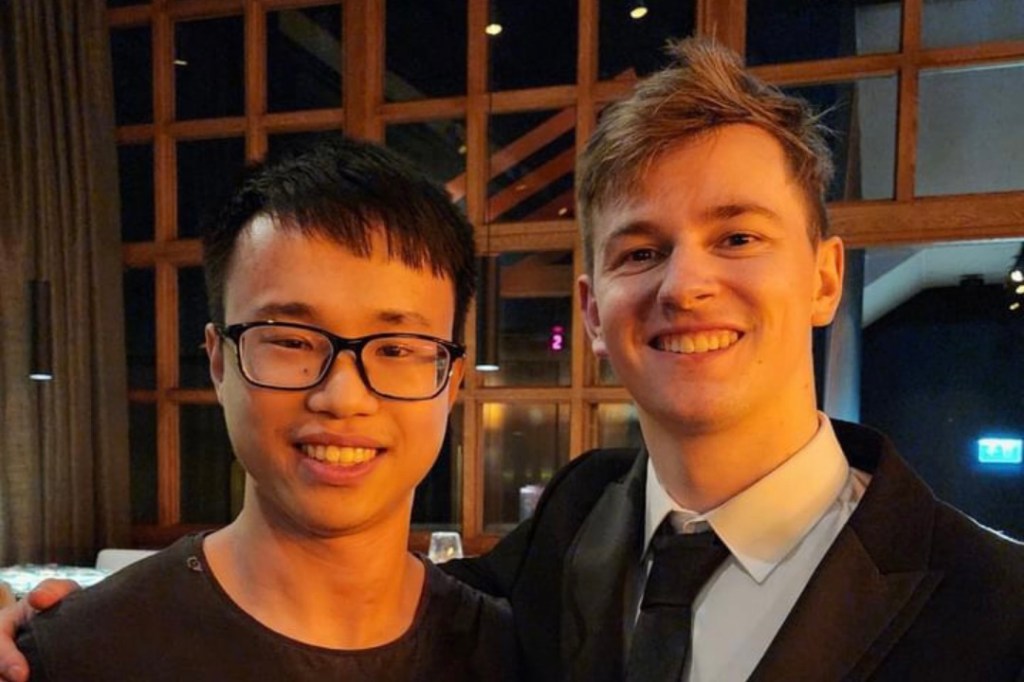
Award-winning students Darren Wong (l) and Oliver Townsend (r). Credit: Darren Wong
Darren later told me: “I am very thankful to all the lovely people in the course who supported me throughout my three years here – I couldn’t have made the best of it, if it wasn’t for all of them.
Like many students, Darren went home “slighly tipsy” that night and said he felt “touched from all the people who congratulated me after the ceremony”.
Darren, who is orignally from Hong Kong plans to work in the UK but has not decided on a city to settle in yet.
Meanwhile, Oliver also has big plans in store. He told me that: “Next up is the Looking China project, which is all I’ve been focussing on for now, where I’ll be shooting and editing a short football documentary in Bejing which I’m really looking forward to.
“Then when I get back, I’ll start planning the project with the PixiPixel equipment, which will be amazing.”
Overall, it was an exciting evening which marked the start of exciting futures for all talent involved.
Every graduating student ought to be proud. We would do well to watch for their names in the rolling credits of future films.
A carbon capture scheme has been proposed for the rural town of Theddlethorpe, Lincolnshire, unsettling residents. Some have declared that they would look to move should it be built. Kara Joubert spoke with a couple who live near the proposed site.
Stay tuned as there is more to be written on this subject as the situation changes and develops.
Read the UCU (University and Colleges Union) criticising the university.
A student-staff meeting regarding the University of Lincoln’s financial stress was called earlier this month. The University, which is currently in a 30-million-pound deficit, held an online meeting with students on May 1st to answer questions and concerns about the current situation.
The Student Union (SU) accommodated the meeting, which management praised for its “fantastic student rep system.” The management team started the meeting by saying, “Students’ opinions matter to us.” In this spirit, students posed several questions through a chat system. The SU selected only a handful to pass on to management.
There were some optimistic statements from management as they sought to justify several of the changes ahead. These changes include cutting open hours for several University buildings, merging schools, and increasing the accommodation costs.
Management clarified that the rise in accommodation is not directly related to the University’s financial situation. There were assurances that the financial difficulties would soon be over. Professor Abigail Woods said: “When everyone returns in September, we’re starting afresh.
“It’s building back better so we can come back with a renewed spirit of optimism, and we can try to put all of these last difficult few months behind us.
“It’s difficult for us to predict what might be coming around the corner. There’s a lot of not knowing, and we can’t give certainty because we don’t have that ourselves.”
When asked if any teaching would move online to cut costs, Prof Gyles Lingwood said: “We’ve got no plans to push our students away from the campus because of the situation we are in at the moment.”
Cuts to staff were not ruled out. Each department has a baseline of savings they must reach, and schools are expected to find ways of achieving this, including redundancies. In schools with a higher staff-to-student ratio, redundancies were described as more likely.
In the meeting, management said that they intend to minimise the impact these cuts could have on students. However, on the University and College Union’s (UCU) website, the UCU Lincoln acting chair Dr Rob Dean said: “It is simply impossible to slash so many jobs without severely impacting current students, future students and diminishing the University’s vital role as a cornerstone of regional education.”
The University is currently suffering a £30m funding shortfall and expects to make 220 staff redundant. According to the University, much of the fault for this situation “has come from outside the University”. However, in a BBC article, the UCU blamed management for the 30-million-pound deficit.
After being approached for a comment, a University of Lincoln spokesperson said: “Universities across the country are being placed under financial pressure by the ongoing freeze in UK undergraduate tuition fees and recent immigration policy changes which are deterring international students.”
With this shortfall, they stated that “almost half of UK universities are forecasting deficits this year”. As a result of this, the University opened its voluntary redundancy and severance scheme.
The current situation contrasts with the University’s 2022-23 financial statement, which said the University remained “financially sustainable for the whole forecast period, with sufficient available cash balances”.
It also noted “extensive financial modelling and scenario planning to ensure that its financial position is not compromised”.
Figures from the financial statement showed that in 2023, the University’s total income was around £240m, a £25.2m increase from the previous year.
The meeting ended after around 50 minutes. Prof Woods reiterated that the University “is not on a precipice of falling over a cliff and closing down” and that further concerns and questions can be emailed to management.
A foster carer has shared her story fostering in Lincolnshire, where the council has announced a shortage of people in the field.
Helen Eedle, 43, has been fostering for 21 years in Alvingham, Lincolnshire with her husband, John. They have supported around 140 children and has seen the foster care system in Lincolnshire evolve through the years.
She said: “I grew up with fostering being quite a big part of my life because my auntie used to foster, and some of my best friends at church were fostered.”
After expressing interest in fostering, the couple received a phone call from the council, asking for them to care for siblings.
Helen is one of the few foster carers in Lincolnshire, where a deficit has been announced by the council. According to the latest Fostering Annual Report, at the end of March 2023, there were 288 foster carer households currently registered.
When asked about the deficit, Helen said: “I think a lot of it is down to the financial climate. But a lot of other regions are offering things like, if you’re having a room for fostering then you don’t have to pay council tax or free bus passes.”
According to the Lincolnshire County Council, payments for foster carers see an average of £181.29 per week.
However, in a cost-of-living crisis, this might not be enough for everyone.
“In the climate we’re in, not many people have a spare bedroom. It’s a big commitment and I know a lot of foster carers find the summer holidays very hard.
“If you imagine how much it costs just to take your own family on holiday, and then they have extra children to find childcare for over the summer holidays, it’s another financial expectation upon yourself.”
However, Helen calls fostering rewarding: “it’s just really awesome really to see how the kids are growing, how they’re progressing and how they’re becoming their own little character and seeing that develop. It’s just lovely.”
Ali Williams, another foster carer in Lincolnshire agrees: “When you have that week when you introduce that forever family to them, it’s so amazing.”
Lincolnshire County Council has objected to the National Grid’s proposal for pylons across Lincolnshire and is calling for an independent review into the project’s costs.
Lincolnshire County Council held a meeting on March 5, 2024, to discuss several matters, including a plan to build pylons across Lincolnshire.
National Grid proposed the project to the council in January.
Many councillors attended the executive meeting to discuss this. Concern among them was high and evident, reflecting local unease.
Among those was Cllr Colin John Davie (Con, Ingoldmells Rural), the Executive Councillor for Economy and Place. He raised objections, saying: “I don’t think there is any kind of understanding by National Grid about the impact and scale of the impact that this proposal will have. Not just on people living nearby to the pylons but also on the agricultural sector the tourism sector and the harm to the character of the county.”
Cllr Davie added: “People often take a cut in money to live in the country and work in Lincolnshire because of that quality of our countryside. This will absolutely destroy quality of the countryside from Grimsby all the way down to Walpole.”
According to National Grid, approximately 140 kilometres stretching from Grimsby to Walpole would house the 50-metre-tall pylons.
Head of Planning Neil McBride raised concerns with the health risks associated with pylons. He said: “100 metre away is the safe zone from them, so that’s a 200-metre line through the countryside on either side.
“So, if you’re spending any time inside that line then you’re obviously going to be at risk from radiation and various other things from these lines.”
The pylons would impact thousands of residents across Lincolnshire, including those living in Boston, Spalding, Burgh le Marsh, Thoresby, Louth, Alford and Withern.
Separate to this meeting, I asked Cllr Travis Hesketh (Ind, Withern and Theddlethorpe) about his view of National Grid’s plan. He said: “Nobody wants pylons in their backyard, do they? I’ve met one person who likes pylons. He says he liked painting them.”
I also spoke with locals in Louth’s Waggon and Horses pub, who shared their distaste for the proposal. Alongside words of “eyesore” and “loud”, one woman told me: “We’ve worked bloody hard to live here.” As previously spoken by Cllr Davie, many people chose Lincolnshire as their home due to the unspoiled beauty and natural landscapes.
Lincolnshire is currently the subject of many large-scale projects, such as the pylons, a geological disposal facility and a carbon capture scheme, all of which have the potential to alter the landscape dramatically.
According to several sources, the infrastructure for the pylons is estimated to cost around £1bn, around four times less than the seabed option. The plan would also include the construction of several substations.
Leader of the council, Cllr Martin John Hill OBE (Con, Folkingham Rural), said: “Frankly, National Grid say it costs four times as much to put it on the seabed.
“They’re saying that would be a quarter of the cost of putting 420 50-metre-high steel pylons all the way down the coast and there they’re telling us that is actually cheaper than putting it on the seabed and really, I don’t believe them.”
After the meeting, the council published an open report stating their objections and concerns surrounding the proposal, alongside a call for an independent review.
This open report stated that: “An independent review of the proposals will enable the council to continue to make the case for a subsea alternative during further rounds of consultation and in preparation for the Council to submit its formal position on the proposal once an application has been submitted to the Planning Inspectorate (expected 2027) for a decision on the application by the relevant Secretary of State.”
Amid concerns for the historical and natural environment around the proposed line, the open report also noted that: “The Lincolnshire coast forms part of the East Atlantic Flyway and is registered as one of the seven sites in the UK on the tentative list for UNESCO World Heritage site status.”
During the meeting, Cllr Davie added: “This is the beginning of a fight and we’re going to have to fight hard if we’re going to protect Lincolnshire for future generations.”
A Lincoln Street Pastor has offered tips to students on how to stay safe while enjoying a night out.
Melanie Carroll is the co-ordinator for Lincoln Street Pastors, which is based in St Benedict’s Church, Lincoln.
According to its website, the organisation is “dedicated to offering practical help on the nighttime streets”.
Volunteers, also known as street pastors, work alongside the city’s bars, pubs, and clubs. Melanie said: “Our goal is to make sure everyone has the best possible evening they can, and that they get home safely.”
According to Lincolnshire Police figures for 2022, 899 violence and sexual offences were reported in Lincoln City Centre alone.
To lessen risks, Melanie recommends half a pint of water for every alcoholic drink, as she says intoxication can lead to vulnerability.
She said: “If you do leave your drink unattended, sacrifice that drink to prevent spiking.”
She also advises caution if someone is trying to separate you from your group. Melanie adds: “If they’re really making you feel uncomfortable, do not be afraid to go up to venue staff and say so.”
Although the number of volunteers fluctuate, street pastors work in groups of three from 10pm to 2-3am on Saturdays and payday Fridays. They can be approached directly or called by venue staff if someone requires it.










 Kara Joubert: Writer, Journalist & Filmmaker